When you buy through links on our articles, Future and its syndication partners may earn a commission.

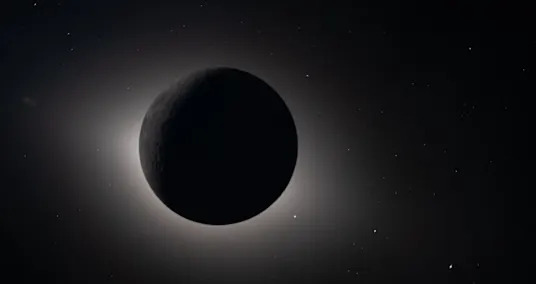
NASA's Artemis 2 astronauts have witnessed one of the rarest sights in spaceflight history — a total solar eclipse from beyond the moon.
The event unfolded yesterday (April 6) as the Orion spacecraft looped around the far side of the moon. This trajectory placed the crew in the right place at the right time to see the moon completely block the sun for about 53 minutes, which is far longer than the maximum period of totality for eclipses seen from Earth.
But it wasn't just the duration that made this eclipse extraordinary; it was the view.
NASA astronaut Victor Glover described the scene unfolding as the sun vanished behind the lunar disk.
"This continues to be unreal. The sun has gone behind the moon and the corona is still visible. It's bright and creates a halo almost around the entire moon," Glover said.
As darkness fell, another phenomenon quickly emerged. "When you get to the Earth side, the earthshine has already shown … almost seconds after the sun sets behind the moon, you can see earthshine," he added.
From Orion's windows, the crew was able to make out the faint glow of sunlight reflected off Earth, while stars and planets appeared in the background. The moon itself became a stark silhouette: "This black orb out in front of us," as Glover described it, edged by the glowing solar corona.

Though a rare sight, it's not the first time a solar eclipse has been viewed from lunar realms. The Apollo astronauts, who orbited the moon rather than flew by it (as Artemis 2 did), also saw solar eclipses, NASA's Kelsey Young, Artemis science flight operations lead, said during a press conference on Saturday (April 4).
The eclipse marks just one highlight in an already historic mission. Artemis 2 is the first crewed journey to the moon since Apollo 17 and has already set a new distance record for human spaceflight.
Following their impressive lunar flyby, the astronauts are now heading back toward Earth and are expected to splashdown on Friday (April 10) off the coast of San Diego.
LATEST POSTS
- 1
 What is ‘Auld Lang Syne’? Why we sing this song at midnight on New Year’s Eve.
 - 2Improving as a Pioneer: Examples from My Vocation
- 3Brazil Passes Law to Use Seized Bitcoin, Crypto to Fund Public Security Measures
- 4The Main 15 Applications for Efficiency and Association
- 5Best Amusement Park in Asia: Which One Is a Must-Visit





- This Unique National Park In Canada Is Famous For Its Otherworldly Limestone Monoliths
- As cases of a rare, deadly infection rise, doctors worry fewer teens will get vaccinated
- Decrease in Home Buy Credits and Home loan Renegotiating Rates: An Outline of Latest things
- Instructions to Utilize the Towing Highlights of the Slam 1500 Productively.
- The Best Internet based Courses for Expertise Improvement
- 15 Outrageous Cosplay Outfits That Will Blow You Away
- Politics at the table? Drinking the wine you brought? An etiquette expert's Thanksgiving dos and don'ts.
- Canada cancels its 1st moon rover: 'It's hopefully not a lost cause'
- $2,000 tariff rebate checks? 50-year mortgages? Making sense of Trump's new 'affordability' proposals.