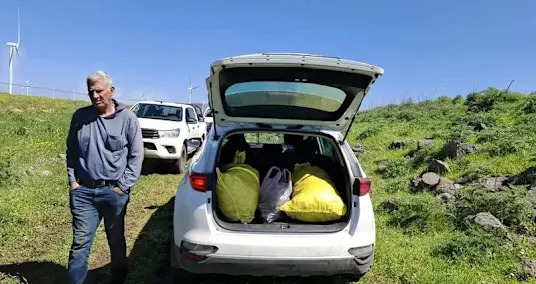
In a separate operation in the Menashe region, an Israel Nature and Parks Authority inspector seized additional sacks containing approximately 6 kilograms of akoub and about 25 kilograms of hyssop.
Approximately 234 kilograms of Gundelia tournefortii (akoub), one of the most sought-after and threatened wild plants in Israel, were seized during an enforcement operation by the Israel Nature and Parks Authority against the illegal picking of protected wild plants.
As part of the operation, an investigation was opened against a known trader and two women who were working with him, after they were caught with approximately 104 kilograms of the plant, raising suspicion of trafficking. In addition, six administrative fines were issued for the possession and picking of approximately 130 kilograms.
The operation was carried out by inspectors from the Nature and Parks Authority in the Golan region, with assistance from Border Police.
In a separate operation in the Menashe region, an Israel Nature and Parks Authority inspector seized additional sacks containing approximately 6 kilograms of akoub and about 25 kilograms of hyssop (za’atar).
Yaron Maderchi, head of the Investigations Department at the Israel Nature and Parks Authority, added that the fight against the illegal picking of wild plants is first and foremost a struggle to preserve nature for future generations.

“We focus on strict enforcement against traders, not on picking for personal use," said Maderchi. "It is important to clarify, there is room for tradition and for responsible use of natural resources, but when picking is carried out on a commercial scale and without oversight, it leads to severe harm and even local extinction of species."
The responsibility lies with all of us to understand the rules, act in accordance with the law, and maintain the balance between humans and nature," Maderchi continued. "Therefore, even if it is a plant with culinary or traditional value, it is important to leave it in nature, to enjoy it with our eyes, not with our hands.”
Widespread illegal picking
The Israel Nature and Parks Authority noted that illegal picking is a widespread phenomenon driven primarily by economic incentives. “Gundelia tournefortii is considered a highly sought-after product in the market, and illegal harvesting can generate profits of thousands of shekels per day," said Oriya Vazana, a regional inspector in the central Golan for the Israel Nature and Parks Authority.
The entire market operates in cash, without oversight, and economic pressure leads people to enter these areas in large numbers," said Vazana. "Beyond the damage to the plant itself, we are also seeing accompanying harm, cutting fences, opening gates, damage to grazing lands, and safety risks on roads. This is a complex issue that requires significant resources, manpower, and targeted enforcement throughout the short harvesting season.”
Gundelia tournefortii is a perennial thorny plant from the daisy family found in the Galilee, the Golan Heights, the Jordan Valley, and other open areas. The plant is characterized by its unique spherical structure. After drying, it detaches from the ground and rolls with the wind, dispersing its seeds.
The plant has significant ecological importance, serving as a food source for pollinators and insects and contributing to biodiversity. At the same time, it is considered a traditional delicacy in Arab society, leading to high demand and increasing pressure on its wild populations.
Due to overharvesting and habitat damage, akoub is classified as a protected species in Israel. Picking the plant, especially when young, harms its ability to complete its life cycle and reproduce, thereby accelerating its disappearance from nature.
The Israel Nature and Parks Authority reminds the public that picking Gundelia tournefortii in nature reserves is strictly prohibited, and that clear restrictions also apply outside protected areas. The public is urged to avoid harming wild plants and to report violations to the Nature and Parks Authority hotline at *3639.
LATEST POSTS
- 1
 Step by step instructions to Remain Spurred While Chasing after a Web-based Degree
 - 2Israel says it killed armed Hamas 'terrorists' in Gaza
- 3NASA to bring astronauts home from space station early due to a medical issue
- 4Scientists dove hundreds of feet into the ocean and found creatures no human has ever seen. Our trash beat us there
- 5Finding Ideal Date Spots for Two or three Encounters




- Ukraine demands army of 800,000 under peace plan
- Understanding the Rudiments of Tree Administrations
- Avoid Large Crowds In Bali & Swim At This Peaceful Waterfall With A Gorgeous, Natural Pool
- Top Frozen yogurt Flavor: Cast Your Vote!
- Addressing sleep apnea early might decrease chances of developing Parkinson's disease
- Figure out How to Keep up with Oral Wellbeing During Pregnancy
- The Force of Mentorship: Self-improvement through Direction
- CMA Awards 2025: Full list of nominations, from Entertainer of the Year to Album of the Year
- Find the Advantages of Careful Eating: Developing a Sound Connection with Food