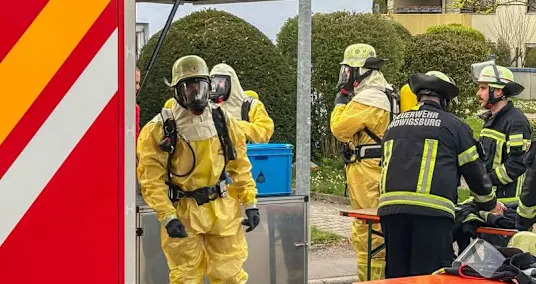
An Easter egg hunt in south-western Germany took a worrying turn on Sunday when two men discovered a vial labelled "Polonium 210" in a garden, triggering an emergency response as authorities tested for the potentially lethal radioactive substance.
District fire chief Andy Dorroch said initial on-site measurements were carried out to detect radioactivity, but all of them came back negative. He added that the two men were unharmed.
The discovery led to a large-scale operation involving the fire brigade and police in the town of Vaihingen an der Enz, north-west of Stuttgart.
It remains unclear whether the 50-millilitre vial actually contained polonium 210.
The fire brigade will secure the vial in accordance with safety precautions, the fire chief said.
Reports said the area around the site where the bottle was found was cordoned off.
According to the Federal Office for Radiation Protection (BfS), the chemical element polonium is particularly dangerous if inhaled or absorbed through the skin via open wounds.
LATEST POSTS
- 1
 Thousands of New York City nurses set to strike Monday if deal isn't reached with hospitals
 - 2I visited every country by 25. Antarctica showed me how much I still hadn't seen.
- 3Why the chemtrail conspiracy theory lingers and grows – and why Tucker Carlson is talking about it
- 4Explosions at Burundi ammunition depot kill civilians, witnesses say
- 5Amateur's Manual for Venture Strategies for Tenderfoots





- 'Stranger Things' star debunks claims of 'unseen footage' from Season 5, Volume 2 as backlash intensifies ahead of the series finale
- German unemployment rate falls to 6.4%, but 3 million still jobless
- Agios Pharma shares jump as US FDA expands approval for its blood disorder drug
- 'Something Very Bad Is Going to Happen' is the Duffer Brothers' first project since 'Stranger Things.' It's also 'wildly insane.'
- Instructions to Construct an Organization While Chasing after a Web-based Degree
- One third of Spanish pork export certificates blocked since swine fever outbreak, minister says
- Glen Powell will host 'Saturday Night Live' with Olivia Dean as musical guest: What to know ahead of their debut
- IDF uncovers 7 km.-long Gaza terror tunnel where Hamas held Hadar Goldin
- Paraplegic engineer becomes the first wheelchair user to blast into space